
A Premium Canadian Resource
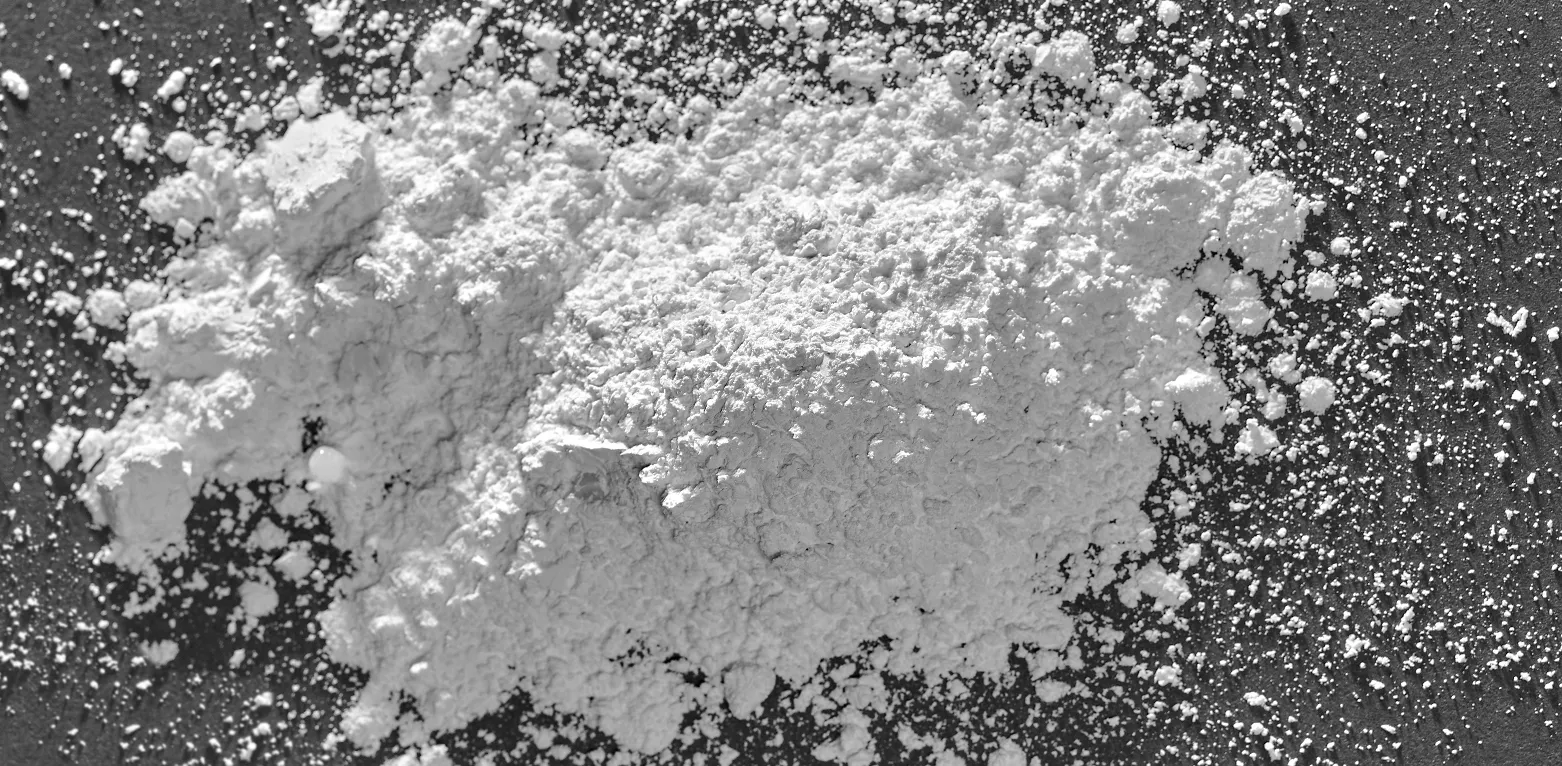
The Covia nepheline syenite deposit at Blue Mountain in Ontario, Canada, is an ESG-friendly, rare, versatile mineral that is 99% pure. The pure-white, consistent-quality, optically transparent filler is the sustainable choice and smart alternative to crystalline silica fillers for a wide range of applications.

Canadian Nepheline has been prized for its qualities since its discovery, right here in Ontario.
Canadian Nepheline is highly cost effective in production processes, with minimal environmental impact. It’s the sheen that makes products sparkle and sets them apart.
It is an inert igneous rock formed out of molten magma. Similar to granite, Canadian Nepheline is made up of three types of minerals; the microcline form of feldspar, the albite form of feldspar and nepheline.
In glass, Canadian nepheline supplies alumina. This provides the final produce with an enhanced resistance to scratching and breaking. Nepheline has a high strength and excellent weather-resistant properties, which are useful in the construction industry.
Canadian Nepheline also enhances the workability of glass batches by lowering the viscosity. It imparts a unique quality of toughness to the glass, making the glass resistant to breakage.
In paints, Canadian Nepheline reduces the need for volatile organic compounds (VOCs), significantly reducing the environmental impact of paints and increasing the safety of their use.
The increase in demand from major markets such as glass, filters, adhesives and ceramics is expected to increase demand for Canadian Nepheline around that world.
WHAT IS
Nepheline Syenite?
Nepheline syenite is an anhydrous-sodium-potassium-aluminosilicate that is a natural, versatile, clean mineral functional filler, which is the high-quality alternative to ground crystalline silica or microcrystalline silica. With similar and, often superior, physical properties, nepheline syenite is the filler replacement you can count on.
Nepheline syenite has low oil absorption and surface area. The low surface area and alkali-aluminosilicate surface chemistry contribute to the ease of wetting, rapid dispersion, and high loading with low viscosity build. Nepheline syenite is also whiter and brighter or less yellow than most mineral powders, yielding cleaner, brighter colors or transparency when required.
Covia’s distinctive nepheline syenite adds performance value to many applications, including plastics, elastomers, paints, coatings, adhesives, sealants, inks, food and beverage packaging, medical supply packaging, greenhouse film, and technical film. This versatifle functional filler enhances durability with outstanding mechanical properties, such as scratch and mar resistance, while improving optical properties with remarkable UV resistance.
PHYSICAL AND CHEMICAL PROPERTIES
Covia’s distinctive nepheline syenite adds performance value to many applications, including plastics, elastomers, paints, coatings, adhesives, sealants, inks, food and beverage packaging, medical supply packaging, greenhouse film, and technical film. This versatile functional filler enhances durability with outstanding mechanical properties, such as scratch and mar resistance, while improving optical properties with remarkable UV resistance.



Planning /
Geology
Let’s start at the beginning when the nepheline syenite is still in the ground. Covia has 50 years of mining experience that we use sustainable and environmentally friendly techniques to mine, process the minerals, and reclaim the land after mining is completed. The Blue Mountain mining team uses sophisticated software applications and mining equipment to ensure the same rigorous environmental standards. One software application, known as a block model, looks on-screen like a big stack of squares representing a 25-foot by 25-foot by 25-foot section of in-situ nepheline syenite. The team will drill a core of the deposit at certain intervals so they can split it, analyze it, and log it for the block model data input. The software reveals if this interval’s geology, mineralogy, and physical/chemical properties are of the quality for which Covia is known.
Overall, The Blue Mountain deposit is high aluminum, low iron, and low calcium, an ideal combination for most high-performance coatings, polymers, and elastomeric applications.
Think of us as your 8-step process industrial minerals experts. With a quality-control check at each step of the way, we …


Sustainability
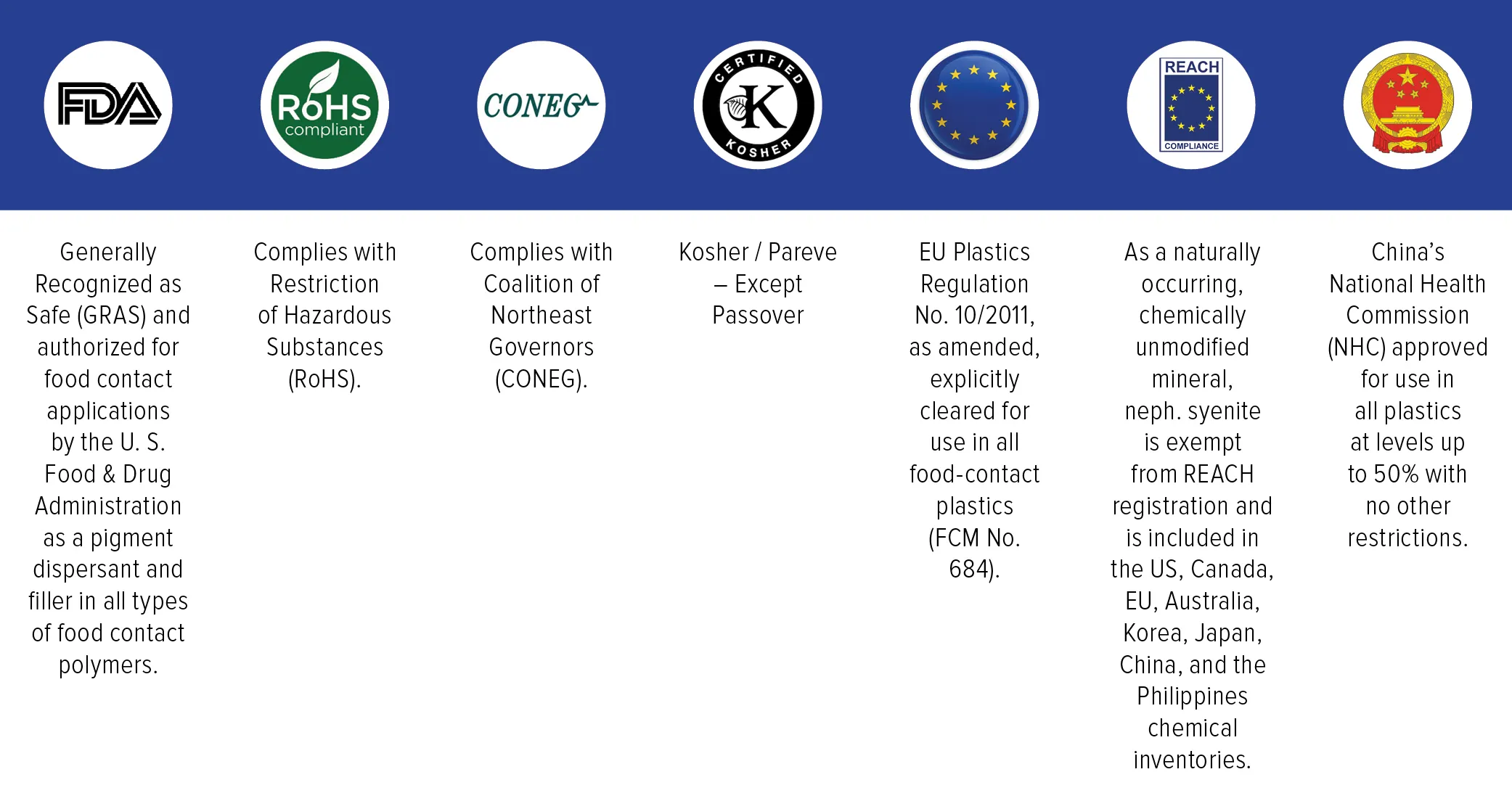
Because Covia’s Blue Mountain nepheline syenite deposit is crystalline-silica deficient, this mineral meets stringent regulatory requirements, including from the U.S. Occupational Safety and Health Administration (OSHA); EU Registration, Evaluation, Authorisation and Restriction of Chemicals (REACH); EU Restriction of Hazardous Substances Directive RoHS; and the U.S. Toxic Substances Control Act (TSCA). Also, U.S. Food & Drug Administration (FDA) Generally Recognized as Safe (GRAS) for indirect food contact in polymer applications up to 50% by weight.
Covia uses a series of dry mechanical processes to mine and manufacture Canadian Nepheline. These processes include crushing, drying, conveying, screening, milling, and classification. No chemicals are used in the process, and Canadian Nepheline itself is inert and non-toxic.
One of the by-products of using these dry mechanical processes is the creation of dust. The drier the conditions – such as very hot, dry summers –can exacerbate the situation.
As our Blue Mountain and Nephton operations are in the midst of prime Kawartha Lakes cottage country, we take the issue very seriously.
The management and staff at Blue Mountain and Nephton have taken extraordinary steps to manage this dust—steps that go well beyond the best practices of our industry.
Covia has invested $1.5 million in tailings dust control measures since 2012, including water cannons, re-vegetation and the installation of rock armour. Blue Mountain also has contingency plans, where gravel or calcium chloride can be immediately applied to any areas that exhibit liftoff.
Blue Mountain utilizes three primary methods to control dust list-off:
- Vegetation – Buckwheat
- Irrigation – Large Water Cannons
- Encapsulation – Rock Armour & Gravel
100 percent of the area is covered by these methods.
Managing Tailings
Tailings from the production of Canadian Nepheline are unlike the tailings found in most mining operations in the world. They are inert and non-toxic. In fact, the tailings provide a natural base to grow and support vegetation.
Crushed rock that is not sold as product can be commingled with waste rock but it is usually placed in tailings storage areas.
Mineral by-products, also known as tailings, are mixed with water and pumped tailings pond where it settles.
Clean decanted water is discharged to the environment as per our ECA.
Covia designed a tailings system that is functional, technically sound and with an environmental footprint that is as small as possible. Covia secured approval for this new tailings design from appropriate agencies, and the first stages have now been initiated.

Fascinating
Facts
The name "syenite" is derived from the ancient Egyptian city of Syene, now Aswan. Syenite looked like hornblendic granite that was widely used as a building material in Syene.